Showing posts with label bookclub. Show all posts

2.24.2012

The Catcher in the Rye: A Month Late

In the fall of 2010 I joined The Book Club Bloggers for their inaugural link up. I was giddy with excitement. From where I sit, book clubs are pure goodness. Whether it's a group that gets together in person, or a virtual one like the BCB sharing a literary experience is a beautiful way to get to know people and exercise your brain. Every time I've participated in a book club, I've come away appreciating the book so much more deeply. Others' insights and takeaways never cease to surprise me and regularly deepen my understanding of the work. From the start I was a faithful member and consistently posted my reviews. I linked up and visited the other member's blogs commenting and enjoying every moment of the experience. But as time went on and life continued to "happen" my posts got published later and later (horrible form, I agree) and eventually I even skipped a month!

For 2o12, Charlotte, the founder and host of the BCB, changed the format of the club a little bit. She proposed that this year instead of members picking books from month to month, we instead spend the entire year focused on banned or challenged books. (read more about the club HERE) I was again excited. Knowing that I would be moving to a land where my social circle would be small, the BCB would be a perfect chance to read a book in community and connect with my lady friends. I was invigorated and ready to renew my membership.

Enter: Life.

In January, the BCB read J.D. Salinger's The Catcher in the Rye. I read right along with them. Since I still had my copy from high school, it was easy to play along. I poured through the book and couldn't wait to hear what the other ladies thought. Only problem, I never wrote or posted my review. See the posts go up the last Friday of the month. The last Friday of January was our second full day in Chicago. Do I really need to explain further? Life happened and my beloved BCB took a backseat.

"I mean how do you know what you're going to do til you do it? The answer is, you don't. I think I am, but how do I know?"
The Catcher in the Rye

In February, the BCB read Stephen Chbosky's The Perks of Being a Wallflower. I still have yet to get the book. I did try. Really I did. But see I have this aversion to buying books at retail price. There are so many used and free books out there; it hurts to buy one at full price. So, I searched the used book store in Chattanooga before we left and I came up empty. (Look at me planning ahead - or trying to.) I scanned Paperbackswap and even joined Bookmooch, attempting to get a used copy. No dice. I still don't have a library card here because it necessitates me taking a written driver's test which scares the hell out of me. So that option was out. So here I sit, on BCB post day still without a copy of this month's book. Once again, life has happened.

Raise your hand if you love a blog post all about someone NOT doing something.

Nobody?

Ya, me neither. So what if instead of doing nothing I use the remainder of this post to talk about The Catcher in the Rye? Even though the linky is closed, I could still be a pseudo-member, right? Cool then, that's what I'll do.
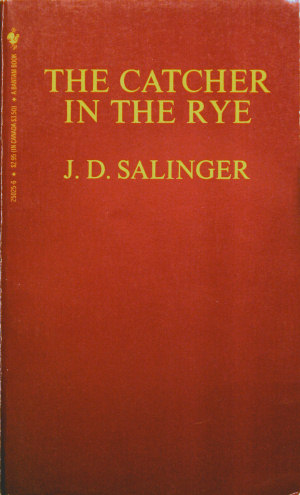

When I saw that the selection for the month was The Catcher in the Rye, I was admittedly relieved. Knowing that January was going to be a busy month, it was a comfort to read a book that 1. I already own and 2. I have already read. I read Salinger's book for the first time in a freshman lit class. Last month when I opened my copy I was immediately struck by notes taken in my high school handwriting. Suddenly the experience became less about reading the book and more about re-reading the book with my high school self.

"Certain things they should stay the way they are. You ought to be able to stick them in one of those big glass cases and just leave them alone."
(Salinger 122)

As a freshman in high school, I thought Holden Caulfield was a rock god. He saw things, experienced things, communicated things in a way that cut straight through all the crap. Holden was able to articulate the angst and confusion and heartbreak that I was experiencing for the very first time. As a freshman in high school I was in a tail spin and just beginning to understand the imperfection of the world around me. Through the haze of hormone and hubris that I viewed the world, Holden seemed to have it just right. We were victims, Holden and I. We were at the mercy of the broken world around us. The best we could do is spit sarcasm as we wait for it to bury us.

Years later, I read Holden completely differently. Now I ache for him. Instead of lifting him up on a pedestal, I wanted to take him in my arms and hug him. I wanted to explain to him, "Yes, the world is broken but there is hope. Even if the world doesn't change, you can." As a thirty something I'm able to see the immaturity, confusion and hurt that fuels so much of Holden's existence. Holden isn't a rock god with all the answers, Holden is a little boy. 

"You could go there a hundred thousand times, and that Eskimo would still be just finished catching those two fish, the birds would still be on their way south, the deers (sic) would still be drinking out of that water hole, with their pretty antlers and their pretty, skinny legs, and that squaw with the naked bosom would still be weaving that same blanket. Nobody'd be different. the only thing that would be different would be you."
(Salinger 121)

Before I turn this post into something sounding more like an hour on my analyst's couch (too late?), let me go ahead and wrap it up. It goes without saying that The Catcher in the Rye is a timeless work of art. Salinger's work is genius and its beauty is heartbreaking. I didn't anticipate the emotional response my second encounter would illicit, but I'm incredibly thankful for experience. I wonder if I read it again in 20 years if it will be something completely different. Perhaps I should try it and find out.

Have you ever re-read something and happily discovered an entirely different book? 

10.28.2011

Book Club Bloggers: A Little Honesty

Book Club Blogger day is here once again. And will you look at that? I'm posting my review ON TIME. Someone mark this date down. Even in a week of veritable silence around A Foreign Land, I am managing to publish my review on schedule. (Look, I have to congratulate myself. Deal with it.)

Moving on to the review...

Guys, can I be honest with you? When I realized this book was a Holocaust story I was a little bit disappointed. Not because I don't see the value in all 20 hundred Holocaust stories that are out there. But more because I feel they're a little bit, "Been there. Done that." Is that callous honest enough for you? There have been and continue to be so many atrocious incidences of genocide in our world and I wonder why oh why the only one that I really ever hear about is the Holocaust. I mean, even the fact that I use the term "Holocaust" and the first thing that enters your mind is the Nazi occupation during the Second World War says something. So well covered is this horrific tragedy, it has taken the little "h" holocaust word to capital "H" Holocaust status.

It's true. I found myself thinking, "Another concentration camp story?"  (And that my friend's is transparency. Bring on the hate mail.)


Because I found Jane Yolen's book to be mildly entertaining, short and easy to read however, I finished it without further complaint. I'll admit it offered a bit of different take on the period than I'm accustomed to. By inserting a modern day character into a concentration camp, Hannah was able to experience the atrocity with eyes more like my own. Even her initial boredom and distaste for her family's Seder rituals mirrored my own boredom with the book's subject matter. This meant by the end, my heart was more pricked than it might have otherwise been by the telling of this tragic tale. Although, I could argue I was feeling guilty rather than genuinely moved. I mean really - what kind of a heartless automaton is "bored" by a Holocaust story?

In summation, I would say that another book about the Holocaust obviously would not have been what I would have chosen to read if left to my own devices. However, if books like Yolen's The Devil's Arithmetic can be tools to begin discussions about The Congo, Rwanda, and Uganda I say, "Keep 'em coming." Frank discussions about these tragedies GOING ON RIGHT NOW are indeed a first step in preventing further hidden slaughters like the one experienced by Hanna, her family and the countless victims of the Nazi regime.

For more bloggers (hopefully less heartless) takes on The Devil's Arithmetic, check out Charlotte's blog The Daily Snapshot.

10.11.2011

Finally....


Remember back in July when the book club bloggers read Love in the Time of Cholera? Remember how I vowed not to let it beat me? Remember how stubborn I am?

Welllllll, I FINALLY finished it. Just. Now.

Like several months later.

But it's finished. Fineeto. 
The dang thing is posted on Paper Back Swap and I don't ever plan on reading it again.

Ever.

I liked the characters less as I read the book. There were times when I was nearly gagging over some of their behavior. As I finished it I grew even more tired of the book's form than I was when I originally reviewed it here. I'm proud of myself for finishing, though I can't say that I took much pleasure in most of the reading experience. 

All that to say, I finished Love in the Time of Cholera and I now intend to re-institute the, "If I don't like the book, I'm not forcing myself to finish it," rule.

8.26.2011

The Dark Side of Nursery Rhymes

It's Book Club Blogger review day and once again I'm playing along. Only this month I'm trying something novel and actually posting my review on the scheduled day having read the entire book.  My track record over the past few months has been a teeny bit spotty. But, this month I'm back on the horse and here to play.

This month's Book Club Bloggers' selection was The Big Over Easy by Jasper Fforde.


The novel is the first in Fforde's Nursery Crimes series and centers around the murder investigation of Humpty Dumpty.  But, let me warn you, this is not yo' mama's Humpty Dumpty.  Fforde's Hump is a hard drinking, womanizing man about town. He, like all of the characters in Fforde's novel, represents the darker side of the world of nursery rhymes. And quite simply, I love the idea.

For the most part, Fforde's prose is simple to read and easy to keep up with. His characters are surprising and entertaining. The humor is very often tongue in cheek and he managed to keep me guessing until the mystery's resolution. There were even a few scenes in which I found myself laughing out loud at the sheer absurdity of the whole thing.

While I can't say that I would rush out to read the entirety of the series RIGHT THIS INSTANT. I will definitely agree that The Big Over Easy was an enjoyable and light read. It was the perfect rest for my brain between the Cholera epidemic (I'm still not finished with that dang book!) and the Jane Austen force feeding (review to come) that followed. Fforde, if this is any indication of the rest of his work, seems to be perfect "vacation" reading for me. I say that because the book had an enjoyable plot, silly characters and short chapters. (I'm telling you, after Gabriel Garcia Marquez, I have come to APPRECIATE a chapter break!)

What do you consider perfect vacation reading?

For even more reviews of Fforde's work, check out the other book club blogger posts.


7.29.2011

Three Pieces of Truth Concerning Love in the Time of Cholera

Ladies and Gentlemen, welcome to Book Club Bloggers book review day.  This month our book selection was Gabriel Garcia Marquez's Love in the Time of Cholera.  Normally this would be the day where I would post my book review chock full of opinions and brilliant reflections on the work. I would do that just like all the other's bloggers who've linked up over at Charlotte's fantastic blog The Daily Snapshot. Unfortunately, this is no normal day.  See, I still haven't finished said book.  I'm only half way through with it. That means I've only got half a review.


This book is heavy.  I don't mean that the material is heavy.  I mean the prose is heavy. It's difficult.  Not difficult/bad, but difficult/meaty.  It takes a lot of chewing to make it through a bite of García Márquez's prose.  Because of the weight of the novel it is taking me a little bit longer than I anticipated.

Funny story, nearly every person to whom I've mentioned that I'm reading this book has reacted in the same way.  They look at me with wide eyes and say, "Oh, ya. I read that book." *crickets chirping* Rather than be warned, I've taken their less than enthusiastic response as a challenge. Instead of throwing in the towel, I am resolved to finish this before I die.  Here's hoping I live as long as García Márquez's characters.  I just may need every moment.


Here's the first truth.  There are moments when I actually like this book.  The prose is quite often stunningly beautiful.  I'm occasionally intrigued by the story line.  Every once in awhile Love in the Time of Cholera tries to get its hooks into me. 

Here's another truth.  I have a serious issue with his form. It makes reading less than enjoyable. What the heck is up with 50 page chapters without ANY breaks? He writes these incredibly dense paragraphs that make up these incredibly dense chapters that require multiple hours of uninterrupted time to read completely (I'm a sloooooooooow reader).  And there are NO BREAKS, just intricate sentence after intricate sentence.  Practically speaking this makes picking up and putting the novel down a bit difficult.  Each time I pick it back up, I generally have to read several paragraphs before I remember what the heck is going on in the story. Now, from an artistic perspective, his form is kind of jaw dropping.  The manner in which he transitions (Did I mention, WITHOUT BREAKS?!?) is astounding. He is able to seamlessly flow from one character's story line to another with utter brilliance. It kind of blows my mind.  With every page that I read, my respect for García Márquez is cemented.  However I'm kicking and screaming my way through nearly every paragraph. Strange dichotomy, you say? I agree.


Now, the third piece of truth I have for you is that I watched the movie. *gasp* I did it to keep my head in the game.  And it worked. I was starting to wane. I was losing steam. I was ready to throw in the towel.  But, the film changed my mind. As I watched what was a lovely film visually, I couldn't help but think, "WOW the book was better."


So, I'm back on the horse.  I can't say that reading this book is always pleasurable.  But I love a challenge.  And it is indeed a challenge.

Have you read Love in the Time of Cholera? 
Are you a fan of Gabriel García Márquez?


6.25.2011

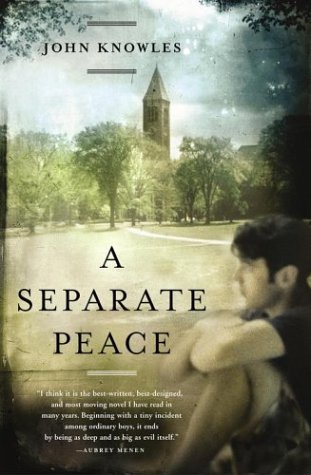
A Separate Peace

It's Book club Blogger review day (well, it was yesterday)!


This month's selection, John Knowles' A Separate Peace was made by yours truly.  So, depending on your reaction to the book, "I'm sorry," or, "You're welcome."

For those of you who haven't had an opportunity to read A Separate Peace, here's the quick and dirty.  The novel is set during the Second World War and centers around Gene (the narrator), Finny (Gene's "best friend"), and a handful of other students at an elite boarding school in New Hampshire.  It's a classic coming of age story chock full of angst that is communicated through beautifully crafted prose. Gene and Finny are textbook foil characters. Gene, the brooding, bookish, rule-follower is the natural literary companion to Finny the larger-than-life, mischievous and athletic big-man-on-campus. The two are involved in an accident that badly injures Finny physically, sends Gene down a spiral of guilt, doubt and shame and forever alters their friendship and lives.

***SPOILER ALERT***

Ok, so, I'm just going to put this out there.  I'm really not 100% certain that Gene intentionally caused Finny's accident. There. I've said it. Honestly, I'm not sure he was proactive and for lack of a better word, strong enough to make such a bold and vindictive move. For me it just doesn't gel with the rest of his character. I bring this up mainly because my opinion on that subject largely affects how I've read this book and what I think of it.

For me the brilliance of Knowles' work is that it dances around the disparity between memory and reality.  As we initially get to know the two boys it is evident that Gene admires Finny and longs to be more like him. This for me became glaringly evident in chapter 3 with Gene's adoption of Finny's phrase, "naturally."  It was my first hint that, in his mind, Gene was attempting to recreate himself in the image of his confessed rival. Gene was unhappy with who he was and desperate to become someone new. (Yep, sounds like high school to me.) As a result, Gene was never an entirely believable nor trustworthy narrator for me.  His recollection of the nature of his relationship with Finny and most glaringly Finny's accident left me full of doubt. As I reread the passage describing the accident, there is no indication in the prose that his "knees bending" were an act of volition.  Yet for the remainder of the novel he speaks as though he intentionally caused the incident.  The chasm there between Gene's perceived memory and what really happened intrigued me. As a reader I was forced to make my own decision and interpret the situation for myself.  There is something enticing about second guessing and not fully trusting the narrator of a novel.  It kept me wrapped up in the story in a way I might not otherwise have been.

Needless to say, I really enjoyed this novel.  As I said before, the prose was beautifully crafted and a pure delight. I found myself underlining passages (which I haven't done since college, by the way) because I was so impressed with Knowles' composition.  All in all, I found it to be an enjoyable read.

But don't settle for my word on the novel.  Head over to The Daily Snapshot to read Charlotte's and the others' reviews of the book.  And feel free to join us next month as we read Love in the Time of Cholera by Gabriel Garcia Marquez.

6.17.2011

Uncle

I guess we should just blame it on The Hunger Games.

I've been a loyal member of the BCB since its inception.  (look there's even a badge right over there on my sidebar - I feel like that's commitment...) I've linked up each month and always thoroughly enjoyed reading everyone's reviews.  But last month I dropped the ball.

Christianna, the girl behind The Girl With the Blue Bow, picked Neverwhere as last month's book club selection. Try as I might to finish the book and review it, I couldn't do it. Perhaps my hunger for Suzanne Collins trilogy had something to do with it.  But I have to admit that my reluctance to finish the book had more to do with the actual book.


I'm new-ish to science fiction as a genre.  And Neil Gaiman's work was just a bit too much for me. Reading it felt more like a chore or assignment than enjoyment.  It's true that the characters in Neverwhere were neither distinct enough for me to differentiate nor compelling enough for me to care about. As a reader, that's a big road block.  And while the novel's concept was intriguing, Gaiman never fully realized the plot in my opinion.  There were just too many questions that I couldn't answer.  There were too many gaps to navigate and I couldn't fully wrap my mind around the "rules" of his created universe.  I found that the constant confusion wasn't pleasant but instead tedious and tiresome.  I wanted to like this book, I really did. But sadly I just couldn't make myself.  So, I'm crying, "Uncle."  I'm admitting defeat.  There are too many books out there to force myself to finish one that I'm not enjoying.  (I'm so sorry, Christianna!)

BUT WAIT! That doesn't mean I'm abandoning the BCB!!!
On June 24th (that's NEXT FRIDAY) we'll be posting reviews of A Separate Peace by John Knowles.  Wanna join the party? Come on, it'll be fun! Annnnnnnnd, since I picked this book, you could all pick it apart the way I have just picked apart Christianna's selection (hangs head in shame).  Head over and check out The Daily Snapshot for a few questions to ponder as you read.


4.29.2011

An Influence I Never Knew I Had

This month's selection A Heartbreaking Work of Staggering Genius by Dave Eggers was recommended by the brilliant (she's a scientist, yo) and beautiful (have you seen her?) Rachael of in goodly colors gloriously arranged.


I knew I was going to enjoy this book before I even finished the acknowledgements.  Before launching into his full on assault of in your face prose, Eggers attempts to outline the major themes of the work. This act in itself made me chuckle, but also prepared me for what the next 300 pages had in store. One of the themes (well many, but this one in particular) struck me as incredibly intriguing.
The Easy and Unconvincing Nihilistic, Poseurism Re: full disclosure of one's secrets and pain, passing it off under a semi-high-minded guise when in fact the author is himself very private about many or most matters, though he sees the use in making certain facts and happenings public. (xxxi)
There Eggers perfectly articulates the tension it seems so, so many bloggers (including THIS blogger) constantly face when writing about oneself and one's life.  And not only does he hit the nail on the head, he does it in a self deprecating and humorous way.  Yep, I knew I was in for a ride.

I was immediately intrigued by Eggers' stream-of-consciousness writing style.  I'm a sucker for a narrator that talks to me, and Eggers had me from page one.  I ate up the awkward and apologetic way he brazenly over shared. Each time one of his friends or family members jumped out of character to criticize or challenge his motives I found myself even more invested.  There's something almost naughty about a book being aware that it IS a book.  I found it to be an incredibly effective storytelling tool.  Eggers refers to this as "gimmickry," but I found it to be totally endearing and intoxicating as a reader.

I saw in A Heartbreaking Work of Staggering Genius a precursor to the style of writing frequently found in today's blogs.  Tell me, can you be influenced by something you've never actually read? Because I believe that I (and many, MANY other bloggers) have been influenced by Eggers' style.  True, it's a memoir.  But, it's a calculated memoir.  The author has an image of himself that he is clearly trying to portray.  The veil is repeatedly lifted but only to manage the readers' perception of who he is as a person.  (perhaps I've just lifted my own veil a bit too high). Though despite his clear machinations, there was never, for me as a reader, a sense of distrust.  I never felt I was being manipulated maliciously.  Instead, probably because he is so forthcoming about it, I understood that he was messing with me.  It made me like both he and his book more because of it.

Truly, Eggers' story is heart wrenching.  The sheer drama of his life experience was enough to draw me in as a reader. However, what struck me more as I read the work was his writing style. A Heartbreaking Work of Staggering Genius is a book I won't soon forget and its stylistic influence will probably sneakily peek out of my writing for years to come.

For more reviews, check out The Daily Snapshot.
Once again, Charlotte is hosting the book club bloggers' monthly read and review!

3.25.2011

Keeping Up the Act


You've heard of hypochondria? And cyberchondria? Susanna Kaysen's memoir Girl, Interrupted caused me to catch a wicked case of bibliochondria.  The book is so brilliantly written, I couldn't help momentarily wondering, "Hmmm, I can totally relate with what she's saying.  Am I a borderline personality?"  Now, before you go committing me, hear what I'm saying.  My bibliochondria resulted from Kaysen's amazingly articulate prose and not my own mental illness I hope.  Throughout the work, Kaysen presents for the reader exactly how fine the line can be between metal stability and instability.  And simply stated, I loved it.  I fell in love with Susanna as a flawed and totally relatable young woman.

Here's a taste of what made me love her.
But I wasn't simply going nuts, tumbling down a shaft into Wonderland. It was my misfortune - or salvation - to be at all times perfectly conscious of my misperceptions of reality.  I never "believed" anything I saw or thought I saw.  Not only that, I correctly understood each new weird activity.
Now, I would say to myself, you are feeling alienated from people and unlike other people, therefore you are projecting your discomfort onto them.  When you look at a face, you see a blob of rubber because you are worried that your face is a blob of rubber.
This clarity made me able to behave normally, which posed some interesting questions. Was everybody seeing this stuff and acting as though they weren't? Was insanity just a matter of dropping the act? If some people didn't see these things, what was the matter with them? Were they blind or something? These questions had me unsettled.
The inclusion of Kaysen's medical records was clever and a very useful literary technique.  For me, they helped to keep my perceptions of the narrator in check.  Just when I would trust her perspective completely her medical records would give me pause.  After all, none of us has a completely accurate view of ourselves.  The records provided an extra layer of play in my interpretation of the truth of Kaysen's situation.  Ultimately, for me as a reader, neither Kaysen's point of view nor the medical records could be relied on as absolute truth.  Instead, I came away believing the truth to be found somewhere in between. (Come on, you know I love a little ambiguity!!!)

Of course before reading page one of the book I made plans to rewatch the film once I had finished.  I saw the film years ago and remembered really liking it a lot.  So much so, in fact, I was worried the book wouldn't hold up.  Boy was I wrong.  After seeing the film for the second time, I can confidently say the book is far superior in my opinion.

What I loved about Kaysen's book is that I was able to read through Susanna's recovery.  The book wound down as she found her way back to the world outside.  Page after page it became clear how Kaysen, as a women, went from being an institutionalized teenager to an accomplished, successful author.  The film on the other hand ends with dramatic Hollywood hoopla.  Lisa is chasing Susanna through the bowels of their hospital and ends up in restraints.  We're given a scene awfully reminiscent of the boiler room scene in Heathers if you ask me.  All that bru ha ha was pure nonsense in my opinion and had nothing to do with the story Kaysen's memoir attempted to tell.  I also found Ryder's Susanna to be angrier and less appealing than the one I read in the book.  This made sense however once I watched the bonus features on the DVD.  Apparently the screenwriter created a Susanna that was an amalgamation of the Susanna in the book and Ryder herself.  That, for me, accounts for the disconnect I felt between the onscreen and literary Susannas. Though many of the book's incidents and even dialogue found their way into the screenplay, the tone of the film was heavier and far less witty than Kaysen's book.

My favorite part of the book was one of the final chapters entitled, "Mind vs. Brain."  I believe it is the most clearly written explanation of the experience of mental instability I have ever encountered. It is a chapter which could have only been written by a woman who has seen both sides of that fine line mentioned earlier. Dripping with Kaysen's wry sense of humor, this chapter convinced me of the book and its author's brilliance.  It also served as a cure for my bibliochondriatic case of borderline personality disorder.  I am now quite certain that I am as sane as the next person.  Unless the next person is Charlie Sheen.  


I read Girl, Interrupted because I am a loyal member of The Book Club Bloggers.  To read other reviews or join in the fun (I'm talking to you Lindsey) visit our hostess Charlotte at The Daily Snapshot.  

Thanks to Laura at Every Path for choosing Girl, Interrupted.

2.25.2011

The Comfort of Foma

It's Book Club Blogger Day!


On tap this month is Kurt Vonnegut's Cat's Cradle courtesy of the lovely and ooooooh so bookishly minded Andrea of The Lighthouse Keeper fame.  If there is one person in the blogosphere responsible for making my "to read" list a mile long, it is Andrea.  So when you're in the market for some great book suggestions (and also your daily dose of just plain pretty images), The Lighthouse Keeper is where it's at... consider yourself warned.

Now, on to my review. (IF you can really call what you are about to read a review.  And I'm not sure you can.)

Several months ago as part of my attempt to complete My 50 Must Reads I tackled Slaughterhouse Five.  When I put the finished book down for the last time I struggled with knowing how to write an appropriate "review."  And when I say I struggled, I mean I struggled for weeks.  This was my first experience with the writings of Kurt Vonnegut.  I felt completely unable to appropriately put into words what I thought about his writing style or the book itself.  I was blocked. It wasn't that I didn't know whether or not I liked it or whether or not I would recommend it.  The answer to those questions was simple, I did and I would. But I couldn't quite put my finger on what I wanted to say and so I just kept my mouth shut.

Enter Cat's Cradle.

Once again, I've read the book.  I enjoyed it.  I would recommend it.  But write  review on it? I'm intimidated.  I've discovered that Vonnegut's work does what many have tried to do but rarely succeed.  Vonnegut shuts me up.  He has a knack for leaving me at a loss for words. Unfortunately for you, my commitment to BCB trumps my scattered thoughts and inability to nail a coherent opinion about Vonnegut's writing. Try to contain your enthusiasm and buckle up I'm not sure where this is headed.

I can say, after my second Vonnegut experience, I'm starting to understand why I'm hesitant to write about my reading experience.  Basically, after reading his books I'm uncertain about my own opinions. My thoughts are all over the place. His biting wit and literary point of view intimidate me.  I finish a book and think I know what he's trying to "say." But I'm never 100% sure.  I keep waiting for him to clearly fall on one side of an argument, any argument, but he never does.  Instead, he skewers both sides.  No one and no point of view is safe or sacred.  Vonnegut is an equal opportunity satirist. I find that pleasantly uncomfortable as a reader because suddenly there is no longer easy clarity.  I'm forced to question who I am and what I believe. His books make me work for it.  And to make the work a bit more difficult, his narrators do NOT seem to be trustworthy.  I'm never sure if I'm supposed to be rooting for them or against them. I constantly question whether what they are saying is insightful or just plain nonsense.  There's a clever playfulness to the prose that hints, "Perhaps the presented truth isn't truth at all."

My confusion hasn't been lessened by the fact that each of these books dealt with charged topics - war, politics, spirituality and the condition of the human heart.  These are subjects where as a reader, I expect the author to voice a solid opinion. But neither book made a crystal clear declaration {to me} where Vonnegut the author stood.  Instead I came away from both novels believing Vonnegut was just trying to tell me that, "This life is utterly ridiculous and is only further complicated by the complex insanity of the human beings with whom we interact."  He seems to scream, "NEITHER SIDE IS RIGHT. STOP TRYING TO FIGURE IT OUT!" I can't help but wonder if Vonnegut's ultimate goal is simply to lampoon any attempt we humans make to understand, clarify, or fully comprehend life.  Is it perhaps that his stand is that we should never take a firm stand?

On the surface it would seem as though the theme of Cat's Cradle is the ridiculousness of faith and the naïveté of those who subscribe to any organized religion or scientifically based worldview.  Yet the book's dedication reads, "Nothing in this book is true.  'Live by the foma (harmless untruths) that make you brave and kind and healthy and happy.' The Books of Bokonon. I:5."  Does anyone else recognize the paradox he's suggesting?  He's basically saying, "Hitch your pony to a wagon you know is probably going nowhere."  What???  That is just crazy talk. Right? 

But here's the thing.  I kind of love it.

Vonnegut's writing appeals to that part of me that remains unsure about life.  He celebrates the truth that we are most wise when we recognize how ignorant we are.  Cat's Cradle is the celebration of faith without logical certainty.  More accurately, I read it as the celebration of faith in what's totally illogical.  But, I didn't come to that conclusion easily.  And still as I write this, I'm not sure that is what Vonnegut was trying to say.  But it turns out, that uncertainty is precisely why I enjoyed the book.  Reading Vonnegut, for me, has been less about what he's saying and more about the process of figuring out what I'm hearing him say.

Well, so much for being at a loss for words...

If you're curious what others have to say about Cat's Cradle you should check out The Daily Snapshot for the Book Club Blogger's reviews.

But as long as you're here, what's your take on Vonnegut? Love him? Hate him? And why???????

1.27.2011

One Day

It's Book Club Blogger day!

This month, Krystal of the lovely blog Village picked our book.  As if I needed one more reason to love Miss Krystal, she went and chose One Day by David Nicholls.


One Day follows the relationship of two people over a span of twenty years.  Dexter and Emma meet for the first time on the day of their college graduation.  Nicholls then brilliantly tracks the evolution of their relationship by checking in with the pair on the anniversary of their meeting, St Swithin's Day, for the remainder of the novel.

I really enjoyed every page of this book.  I found Nicholls writing style to be completely engaging.  I thought the plot structure was fun and found the yearly check in tool to be one that was new to me as a reader.  I immediately connected with both main characters.  And being relatively ignorant of English culture, other than what I've seen in the movies or on the "tele," (check it, I'm totally becoming an anglophile) the book felt like a mini holiday to a not so distant destination.

Truly though, for me, writing style and subject matter are important but to really lurve a book it has to touch me emotionally.  I'm less of a technical reader and more of an emotional one.  There is no question, One Day touched me.  I think the character's growth (or lack of growth) spoke to all of my multiple personalities.  Now, before you start prescribing meds, let me explain.  Emma's idealism and radical desire to change the world spoke to the 20 something girl that I often forget I no longer am.  Dexter's aimless travels reminded me of how lost I felt after my own college graduation.  Uncertain of how to be a grown up or what to do with his life, Dexter packed his bags hoping to find answers anywhere but home.  The way Emma wondered what her "22 year old self would think of today's Emma..."  That is a thought I have probably once a month, if not once a week.  Dexter's self destructive thirst for accolades and "fun" that inevitably lead to despair and embarrassment courtesy of his professional binge drinking.  Each incident was a reminder of where I no longer live. Emma's realization that her life which lacked some of the "exclamation marks and underlining," might not have the intensity she once thrived upon but was comfortable and satisfying just the same. The ability to personally connect with the characters made One Day incredibly appealing and thoroughly moving.

I found Nicholls' story to be bittersweet and satisfying.  Even when the reader ultimately gets what is promised from the first page, One Day doesn't offer up the expected, fairytale ending.  Instead, Nicholls provides beauty and hope mixed in with his character's sorrow.  It proved to be an intoxicating and enjoyable read that I would absolutely recommend.

For more opinions, you should check out The Daily Snapshot for this month's Book Club Blogger reviews.

In related news, have you heard the movie adaptation of the book is set to be released by Focus Features this Fall 2011?  Anne Hathaway & Jim Sturgess will play "Em & Dex, Dex & Em."

{Sturgess image}

I feel like the casting department did a really decent job.
But what do you think?

12.31.2010

The "Click" Unclucked

It's Book Club Blogger Review Day!

This month the club's selection, Tove Jansson's The Summer Book, was chosen by Cydney the voice behind Material Lives.


I wanted to like this book.  I really did.

As mentioned earlier, when I started it I just didn't "get" it.  I couldn't find a plot line, the characters weren't drawing me in and it was structured in such a way that I couldn't figure out what the heck I was reading.  Miraculously somewhere in the book's middle I fell in love with a chapter and had high hopes of a drastic turn. {It was the chapter in which Grandma & Sophia break into the "new neighbor's" house.} Alas, the turn was not to be.

Here's the thing, this book made me feel stupid.

I completely missed the point that I'm certain exists.  I just could not connect with the author's writing style.  It felt incoherent and its lack of continuity was confusing and seemed disorganized. The whole time I was reading it I felt as though I was at a dinner party where the rest of the guests spoke a different language.  I was continuously frustrated that I could hear the conversation going on but it made no sense to me. Throughout the book I caught glimpses of imagery that pointed toward some hidden jewel.  But try as I might, I was unable to connect the dots and uncover the treasure.  Though one chapter led me to believe that perhaps the story had finally "clicked," I disappointedly discovered in the next chapter that the click had unclucked.  (Pretty sure I just made up a word there.  You heard "unclucked" here first, folks.)

I'm quite certain an enormous part of the problem was how and when I read The Summer Book.  Reading it during a hectic time of year, in a very disjointed way did me no favors.  I read 3/4 of it at the beginning of the month and the last few chapters earlier this week in an effort to force myself to finish in time to publish this review. I also read it right after Little Bee and read (the pretty hysterical) Hypocrite in a Pouffy White Dress during the same period.  Both of those books are written in a much more "in your face" style.  As a reader, I never felt like I was searching for meaning, it was crystal clear on every page.  Reading The Summer Book in their midst lead to unfair comparisons on my part.  Perhaps sitting down with The Summer Book and reading it in one fell swoop or giving it my undivided (read: non-Holiday) attention would change my opinion.

But frankly, I'm intimidated.  I don't particularly like to feel like I'm the only English speaker at the party.  It's unsatisfying (and a bit demoralizing) to so thoroughly miss the point.  In the end though, I recognize that perhaps the problem is that I didn't take time to learn the language before going to the party; not that everyone else is enjoying the conversation. 

I can't wait to read the other club member's reviews and reactions.  {Did you guys speak the language?}  You can read what everyone else thought too by visiting Charlotte's blog The Daily Snapshot.

12.10.2010

It Took A Minute...

I started reading Tove Jansson's The Summer Book right after finishing last month's book club blogger post. 

What? I didn't want to be late again...
(deep down inside I'm still a closeted straight A student)

So, now I'm almost finished with the book and I'm going to be totally honest with you.  At first I did NOT get it.  But, about 2/3 of the way through, it clicked.


Want to spend some of your free time over the next couple of weeks (BAhhahahahaha) by reading this book and participating in our book club?  No, but seriously, you should check out Charlotte's blog, The Daily Snapshot, for more info on the club and some questions to ponder as you read the book.  I promise it will be worth your time.  Pro. Mise.

Don't let my cluelessness and difficulty understanding the beginning of the book scare you away... join in the fun, join in the fun.


11.29.2010

"A Scar Means, I Survived"

I'm a bit late on my book club review...


I have a confession to make, I didn't even finish reading the selection until Saturday (the day AFTER the book club posts were scheduled). I realized last week, probably about Monday or Tuesday that there was no way that I was going to make the deadline.

Charlotte, can I please get a pass? I'm sorry that I'm turning my report in late. I have a laundry list of excuses that I'll spare you from hearing (unless I need them).


I promise my tardiness is not a reflection on this month's selection, Little Bee, by author Chris Cleave.  The book has kind of left me reeling.  In fact, I feel like I probably need MORE time to process it properly before writing a truly thoughtful review.  But, I'll give it a stab anyway.  There were many, many things I enjoyed about the book.  The first being the voice of the title character herself.

From the first chapter I was drawn into the book, not because I felt passionate about the story or the issues it raised, but more because I fell in love with Little Bee.  As a character she possessed strength and resilience without compromising her gentle heart or her sense of humor.  Though she was a victim, she continued to fight to keep her life (or death) from being dictated by the atrocities she had experienced. 

While the story line itself was not particularly captivating to me, (the whole immigration issue just makes my head and heart hurt... it's one that I shamefully admit to pulling an ostrich on because I don't see an easy/right answer) Cleave's skillful prose and literary techniques kept me turning pages.  I particularly enjoyed how he structured the novel.  The way the story began in the middle and slowly built momentum by revealing details backwards through time was clever.  But I was pleased when he then quickly jumped back to the story's middle to move forward toward its conclusion.  It made the novel just non-linear enough to keep me interested without totally confusing and frustrating me.

But his words... wowzers. There was a wealth of memorable passages so beautifully written that I was tempted to pull out the highlighter just so I wouldn't lose the rich and weighty prose.  Not only are they poetic they are often razor sharp.  Cleave is a master wordsmith.
"Imagine how tired I would become, telling my story to the girls from back home.  This is the real reason why no one tells us Africans anything.  It is not because anyone wants to keep my continent in ignorance.  It is because nobody has the time to sit down and explain the first world from first principles.  Or maybe you would like to, but you can't.  Your culture has become sophisticated, like a computer, or a drug that you take for a headache.  You can use it, but you cannot explain how it works.  Certainly not to girls who stack up their firewood against the side of the house." (128)
While I'm still not sure that I loved every element of the book's plot, I am so glad to have experienced (and frankly to still be experiencing) Little Bee.  I would definitely recommend it to others and I can't wait to read the other book clubber's insights.  Most importantly, it's already forced me to pull my head out of the sand and begin to contemplate the immigration issue for myself.  {That alone made it a worthwhile read.}


For more reviews of Little Bee check out Charlotte's blog The Daily Snapshot.

Okay, so I'm opening up the floor... got any thoughts on Immigration?


11.17.2010

Book Club Bloggers - November Edition

On Friday, November 26th the Book Club Bloggers are all waking up from their turkey comas & halting their Black Friday shopping sprees to discuss this month's selection Little Bee.  (Well at least all the American members are... the members who live elsewhere around the world are just participating like it's any other old Friday.)


Chris Cleave's novel is a #1 New York Times Bestseller and although I'm only one chapter into it, I'm pretty sure I'm going to enjoy it.

Helen over at Plant My Appletree selected the book this month and she's made a bizarre and super cool request.  She wants us each to pick up the book knowing as little about it as we can.  No reading reviews, no researching synopses (is that the plural of synopsis?), no snooping.  I've done my best and haven't even read the back cover.  I'm going to be honest... it's killing me. 

But the first chapter has grabbed me, and I sooooo wish I could tell you why.  But I can't.  So, I guess you'll just have to find your own copy.  Read it.  And join us all at Book Club Blogger Central a.k.a. The Daily Snapshot and let us know what you think on November 26th.  As usual, Charlotte will be hosting the fun.

You can click the link below for more information on the club itself, for questions to consider AFTER YOU'VE READ Little Bee, and also for advance notice regarding December's book club selection.


You'll notice I didn't link to the book anywhere in this post so as not to tempt you to read anything about it.  You're welcome.

 
So, are you in??


10.29.2010

Book Club Bloggers - Interpreter of Maladies

It's book club time again!!
This month we've all read Jhumpa Lahiri's Pulitzer Prize winning collection of short stories:


The first time I read Interpreter of Maladies we had just moved to Chattanooga.  Check that, we had just moved to Cleveland, TN (30 minutes outside of Chattanooga, Cleveland makes Chattanooga like the "big city").  My husband was away for a month of training for his new position and I was isolated.  Nothing in my world seemed familiar.  There wasn't a single person that I knew for literally 100s of miles in every direction. And though we were on the brink of what has turned out to be a great adventure, I didn't quite see it that way at the time.  I was a stranger in a very foreign land.  While it may seem dramatic for me to compare my move from St. Louis to Chattanooga to Lahiri's characters transition from India to the United States.  I assure you, at the time, the common theme of isolation among her characters seemed all too familiar to me.  Our cultural differences were insignificant.  I connected with the stories at the heart level.  That connection was powerful and I recall putting the book down when I was finished and thinking, "This might be the best book I've ever read."

A passage from the story Mrs. Sen's sums up what I took from my first encounter,
"Do you miss your mother, Eliot, these afternoons with me?"
The thought had never occurred to him.
"You must miss her. When I think of you, only a boy, separated from your mother for so much of the day, I am ashamed."
"I see her at night."
"When I was your age I was without knowing that one day I would be so far.  You are wiser than that, Eliot.  You already taste the way things must be." (122-123)
Isolation and the rebuilding of community were the powerful messages that stuck with me. Hmmmm, I wonder why?
Reading it again, several years later I find myself once again deeply moved by Lahiri's writing.  Her storytelling is so incredibly rich.  The depth of character she achieves in the short story format is borderline miraculous.  And once again, I am struck by the fact that though many of her characters are unique to the Indian American culture, their experiences and emotions are universal.

This time, I've fallen in love with different stories.  (Isn't it cool to re-read a book when you're life is in a different stage???) 
**SPOILER ALERT**
Knowing how it would end from page one, A Temporary Matter wrecked me this time through. I read it the first time anticipating a reconciliation and looking for clues that the marriage was to be restored. This time I experienced the couple's bitter sweet farewell paragraph by paragraph.  Instead of simply being turned off by the Das family's ugly Americanism, I was struck by how quickly an emotional affair can be conceived and carried to fruition while reading the title story, Interpreter of Maladies. Lahiri brilliantly depicts how easy it is to romanticize an individual, as Mr. Kapasi did with Mrs. Das, before really getting to know much of anything about the person. Instead of seeing The Third and Final Continent as a picture of a foreigner in a foreign land doing what he could to survive, I marveled over how each unfamiliar step brought him closer to the love story with his wife and the lives of their future generations.

I'm a huge fan of short stories.  And I'm an even bigger fan of Lahiri's short stories.  To be able to communicate enormous narratives with a limited ration of words is a gift.  Plus there is something about only being privy to just an episode of a character's life.  It allows the reader to imagine a beginning and end all for ourselves.  We can fill in our own details.   For me, this participation in the story telling makes it all the more engaging.

Interpreter of Maladies is a work that has been a joy for me to read again.  Though Lahiri's subject matter is often heavy and her stories can be a bit dark, it never felt like too much.  That's probably another benefit of the short story format.  Perhaps full length novels of any of these stories might have proven too intense or depressing.  Instead this collection left me yearning for more of her work and waiting for another collection of stories to dive into.


Click Here for the Other Member's Reviews

Have YOU read Interpreter of Maladies?  If so, what did you think?
(If not, I hope I haven't kept you from doing so with my spoilers)

10.06.2010

Book Club Bloggers - October

You know what I've discovered is the best part of belonging to a book club?  Getting to see a book through the eyes of the other participants.  There is just no denying that it is better for me to read a book in community than all alone.  I get so much more out of my reading experience.

So when I was offered the privilege of choosing this month's selection for the Bookclub Bloggers, I was tickled.  How much fun will it be to see one of my all time favorite books through the eyes of the other participants?

This month's selection is:

Interpreter of Maladies
by Jhumpa Lahiri


This collection of nine short stories is one that I've loaned to countless friends and family members.  A winner of the Pulitzer Prize in 2000, what I find most intriguing about the book is that it is Lahiri's DEBUT work.

I am so excited to read it again, and I'm hoping YOU (yessssss, YOU) will read it along with us.  Then since you've read it, you should participate in the Bookclub.  You don't HAVE to be a blogger to participate.  Charlotte, the head chick in charge, will be happy to help you non-bloggy types participate.

Click this button for all the information you could ever need:


In case you're looking for a little bit of info on the book, read this interview with Jhumpa Lahiri.


The book club members will be posting their reactions to and reviews of Interpreter of Maladies on October 29th.  You still have plenty of time to track down a copy and get to reading it.  My suspicion is that you will not be disappointed.  But, neither of us is going to know until you read the book. {subtle, right?}  I'm really excited for the opportunity to see this book through other reader's eyes.

What do you say?  Are you IN? 

9.24.2010

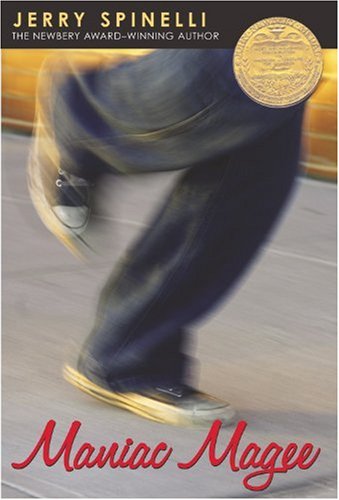
Book Club Bloggers - Maniac Magee

September’s Book Club Bloggers’ selection, Maniac Magee, and I got off to a rough start. I was completely unfamiliar with the book.  So, when I went to pick it up at the library I was a bit disappointed to discover that it was in the CHILDREN’S section. Not the young adult fiction section but the actual JUVENILE section. It was in with the chapter books and the "Choose your own Adventures." Now, I love a "Choose your own Adventure" as much as the next girl, but I was a bit worried about reading and blog discussing a juvenile book. Despite my snobbery hesitation, I decided to bring Maniac Magee home and give it a try.


I’ve got to tell you, the book left me a bit confused.

I can’t write a glowing review, because I didn’t LOVE it. But I can’t write a scathing review, because I didn’t HATE it. For me, the book was just kind of ho-hum. I didn’t connect passionately with any of the abundance of characters. I wasn’t convicted by the author’s message or inspired to make changes in the world – which is a bit surprising given the weight of the issues Maniac Magee addresses. But what is most damning is that I never found myself dying to pick it up to see what happened next. It felt more like a reading assignment than reading for enjoyment.

In short, Maniac Magee is the legend of a homeless boy who does all he can to integrate a community. Framing the plot of Maniac Magee as a legend removes it from space and time and allows Jerry Spinelli to comment on both race relations and homelessness from a detached point of view. Two Mills (the town in which a majority of the story takes place) could be anywhere and the title character could have lived at any time. Having lived in two very segregated cities (both St. Louis and Chattanooga have color lines that remain drawn) I would argue that it’s a story that could be set in the present. But I will admit that as I read it, I pictured a world that looked more like an America depicted in movies and sitcoms of the 70s than today. Writing Maniac Magee as a legend was a clever move on Spinelli’s part, in my opinion. A lack of grounded time and place allow the reader to focus more on his message and less on the specificities of a particular place or time.

The tender relationship Maniac shared with Grayson is what saved the book for me. The warmth of their interaction and their sweet dependence upon one another was an unexpected bright spot. As for the rest of Spinelli’s book, I found it walking a line just like Maniac did at the end of Part 1. Except, instead of being taunted and beckoned by a black community on one side of the street and a white community on the other, Spinelli managed to JUST escape preachy soap boxing calling him to one side and predictable, uninspiring story telling on the other. Thankfully, just like his character, Spinelli made it out of town without fully falling victim to either bully and produced what was for me, a mildly entertaining story with a few bright spots of interpersonal connection that made the remainder tolerable.

Now, I can't wait to read what everyone else thought about it.  You can too.  Just hop on over to The Daily Snapshot and take a look at all the other Bookclub Bloggers' posts!


Not sure what I'm talking about????
Click this button for more information on the book club.


9.18.2010

Blogger Book Club - Maniac Magee

It's nearing the end of September which means it's almost Bookclub time again!!

This Friday (September 24th) we'll be posting our bookclub entries for September.  And you should join in the fun.  I've mentioned before that I'm tickled to be part of the Bookclub Bloggers (a super cool group started by Charlotte at The Daily Snapshot).  Please know, the invitation is WIDE open to you too.  The more the merrier.


click this button for more details


In case you're wondering, this month's selection, Maniac Magee was chosen by Katie (the co-founder of BCB) at Life of Piefairy.


I've not finished Jerry Spinelli's novel, but here's a quick tease:
Maniac Magee was a legend. Kids were always talking about how fast he could run; how high he could jump; how no knot would stay knotted once he began to untie it.  But the thing Maniac Magee was best known for is what he did for the kids from the black East End and those from the white West End of Two Mills.  Maniac Magee was special.
Since the book is young adult level it's proving to be a really fast read.  Come on now, don't you want to be a joiner?

8.27.2010

The Giver


I kind of have first day of school butterflies in my tummy as I write this post. I’ve been so excited to be a part of the bookclub bloggers. Now as I write and post this I feel all nervous and giddy. Eeeeee, it’s finally here.

In case you don’t know what I'm talking about, I’ll give you the quick and dirty. Charlotte over at The Daily Snapshot is hosting the inaugural meeting of the bookclub bloggers. Once a month we’ve committed to read a selected book and then, since we’re all spread out and can’t get together to chat about it, we’re having a linky party at her blog to share our thoughts.

This month we read Lois Lowry’s The Giver.


The book was first published in 1993 and won the 1994 Newbery Award. It also holds the distinction of being one of the most frequently challenged and banned books since its publication. Dubbed “The Suicide Book” the controversy was covered by USA Today in 2001. That, for me, just made it so much more exciting to read. Though, I must admit I'm not sure what all the fuss is about. (And I rarely am when it comes to banned books… probably a whole other post.)

The Giver was a treat for me from the moment I picked it up. Having never read the novel before, I had no idea what I would discover inside that easily recognizable cover. I was tickled when I learned it was a work of science fiction. Though I’ve only read a handful in my life, science fiction (well, well written science fiction: Bradbury, Huxley, Atwood, and now Lowry) is fast becoming one of my newest indulgences. The world created by Lowry in The Giver did not disappoint.

I must admit I was initially intrigued and enticed by the seemingly "Utopian" society in which Jonas, Lowry’s 12 year old protagonist, inhabits. A world free of stress and strife, where the tough decisions are either dictated or removed all together sounded a teeny tiny bit appealing for a moment or twenty. Deeply felt emotions can get messy and who wouldn’t like a world where people are forced to be polite. (Well, I wouldn’t want to be forced to be polite, but it would be nice if everyone else was forced to be polite to me.) So, I'm admitting that maybe for a second I considered Jonas’ world to be enviable. Which, I believe, is the beauty of Lowry’s prose; she draws the reader in and you become invested in this world she has created. But just when you feel bizarrely at ease she flips the script. Slowly that initial comfort and attraction is stripped away as more and more truth is revealed.

And boy oh boy do I love a book where the ending is left up for interpretation. Certainly there are some clues that point toward Jonas’ actual fate, but there are more than a few questions the reader is left asking. I. Love. That. For me there is nothing better than a book that continues to mess with your mind long after you finish its final paragraph. I believe I’ve finally settled on an ending that I find satisfying for now. (I won’t share it here in case you haven’t read it… and if you haven’t read it, go read it. Like now.) But, I have a feeling that if I were to pick up The Giver and re-read it several years from now, I may come to a totally different conclusion. It is that kind of book. The Giver is nuanced and rich without ever feeling overworked or dense. Lowry packed a mighty story into a mere 180 pages, and she did it with style and intelligence and most importantly she did it without making the reader a passive observer. When reading The Giver I couldn’t help but engage and interpret and imagine and analyze.

That being said, I did find myself occasionally having to just let go and go with the story. There were a few loose ends that I had difficulty connecting. With a couple details that don’t seem to fit the reader is asked once or twice to suspend disbelief. But when we’re talking about science fiction, is that really a surprise?

In the end, Lowry manages to present a compelling story, characters that the reader quickly cares about and a world that will mess with your mind.

I'm curious about Lowry’s companion pieces Gathering Blue and Messenger written several years later. Apparently the three are part of a trilogy. Has anyone read them? Are they worth my time?